by Esper the Bard
•
Updated 8 months ago
Year 525–537 of the Age of Conquest
Video Version: See this record in video form
“If history proves anything, it is that mortals are at their worst when they try to be as gods.”
—Gwydion Silverheart
The War of Three Dooms was one of the most devastating wars ever in the world of Ichoros. This conflict spanned across multiple realms, and saw the use of apocalyptic magic weapons called allabons, which annihilated life on a mass scale. The “Three Dooms” is a reference to three realms where allabons were deployed: Jaia, Magneland, and Drekkengrim.
The preconditions leading up to this war go far back in history, though the war itself took place from the 525th–537th year of the Age of Conquest. This means it ended about 80 years ago in the current timeline as of the creation of this record.
Here are some of the major events associated with The War of Three Dooms.
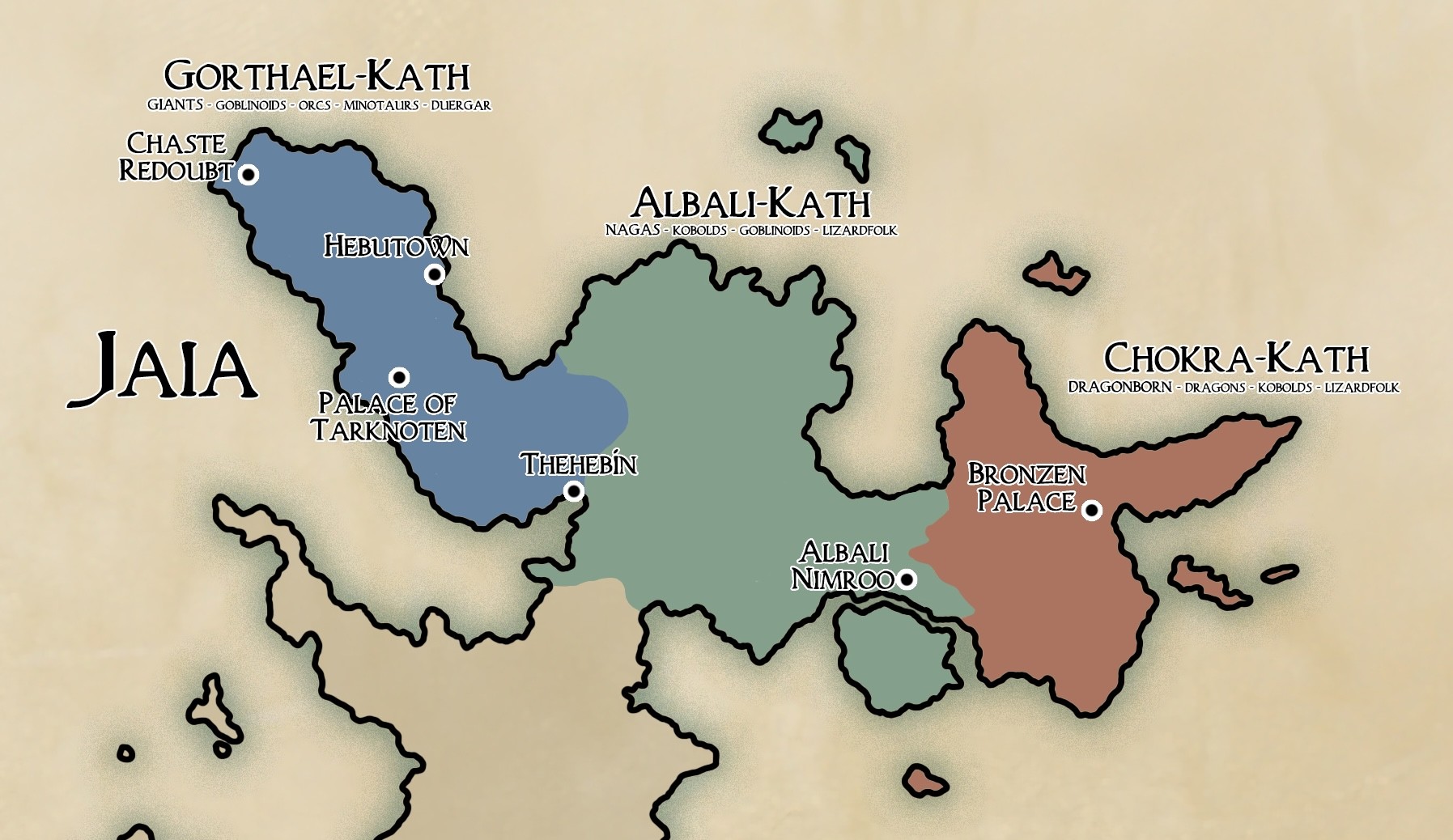
Jaia is a realm in the southwestern part of the known world. It is composed of three large kingdoms. Gorthael-Kath in the west, which is ruled by giants; Albali-Kath in the center, which is ruled by nagas; and Chokra-Kath in the east, which is ruled by dragonborn.
Hostilities between these three states have existed since time immemorial, stretching back far into the Age of Cataclysms, when gods and titans existed physically in the world and battled for dominion. Jaia was a very beautiful land in those days, though it suffered from countless clashes between beings of superior power. Three gods rose to dominance out of these epic battles, with their followers in the eastern, central, and western regions respectively. Rivalries among them worsened until eventually, they became enemies and wars ensued. From this history, the three super-regions of Jaia evolved, always with bad blood between each other.
So, when all-out war erupts in the 525th year of the Age of Conquest, it is initially called The Kingdoms' War. The giant-led Gorthael-Kath and the dragonborn-led Chokra-Kath both launch major offensives against each other at the outset of the war. The naga-led Albali-Kath declares neutrality, but this is little more than a formality. Their long-term goal is to let the giants and the dragonborn wear each other down, then finish them both off. But fighting spills over the borders on both sides, with raids and resource seizures becoming common. It is not long before Albali-Kath makes counterattacks and begins covert operations in both the east and the west, including magical strikes against critical targets.
It is also worth noting that, although the conflict is contained to the realm of Jaia at its outset, there are already a number of allies and enemies in realms outside of Jaia—particularly in Bazagon and Magneland—who quickly become involved. This involvement is political and trade-based, in terms of the profit made from supplying resources to the kingdoms of Jaia. As well, a few mercenary companies go to fight in Jaia, seeing it as a war so lucrative as to be a once-in-a-lifetime opportunity. If only they had known just how dreadfully correct they were.

The Kingdoms’ War has been raging in Jaia for a little over a year, and tensions are increasing on the world stage. The situation is notably volatile in Magneland, the Great Realm, a large nation in the north and northeastern part of Ichoros. Magneland is also a land fraught with its own series of wars and conflicts throughout history.
House Cantarelle of Vencelok in eastern Magneland has long been on diplomatic terms with Fothagal the Dread Blue, an ancient dragon who is king of the dragonborn nation of Chokra-Kath in eastern Jaia. King Sondor Cantarelle of Vencelok sends mage-consuls to the Bronzen Palace of Chokra-Kath. They trade arcane secrets with the royal sorcerers of Fothagal and begin the clandestine development of allabons, magical superweapons with the potential for god-like devastation. Not only is Vencelok interested in claiming dominance in Magneland, but they have learned that House Alexi of Kostroma, in southern Magneland, together with House Alturox of Vandyagash, in northwestern Magneland, are also in the early stages of developing allabons. These regions of Magneland have a long history of conflict, and House Cantarelle is naturally concerned over the prospect of its rivals gaining such an upper hand.
House Alexi later goes on to hold similar councils with leaders in Albali-Kath, and House Alturox does the same with leaders in Gorthael-Kath, all striving desperately to find the answers to the completion of the allabons.
At the closing of the second year of The Kingdoms’ War, the conflict shows signs that it will only intensify. Leaders in Magneland and Jaia are working exhaustively to construct mega-artifacts in the hopes of defeating their enemies and achieving victory. They know that they are reaching for unprecedented power, but they cannot imagine the costs that such a victory will entail.
As a sidebar, there existed a great mystery for many years after The War of Three Dooms, as how it is that the great houses of Magneland all had partial knowledge of how to create allabons. The revelation came in the latter phase of The Infernal War, when the archfiend Nergoy managed to merge a region of Hell with a region of Jaia. In his conquest of the world, Nergoy wielded the most powerful allabon ever known, The Voidstar. Indeed it had been Nergoy, all those years prior, who sold arcane secrets to the Magnelander kings—powerful, yet incomplete information, and all part of his infernal machinations.
A little over two years have passed since the onset of The Kingdoms’ War. Blood spills across the whole of Jaia, and Magneland is a tinderbox. It is only a matter of time before the violence spreads. The situation in Bazagon has also grown perilous. The Bazakánon Republic, the Melysis Hold, and the Dweomer Enclave have political and economic ties to Gorthael-Kath, and the Melysis Hold in particular has religious opposition to the dragonkind of Chokra-Kath. At the same time, the Xanthos Throne and the Argus Legion of Bazagon have ties to Chokra-Kath. This means that Bazagon City, the jewel of civilization and the mecca which holds the highest amount of corpus-idols, is ripe for internal and external conflict.
The geography of Bazagon is quite peculiar, which greatly impacts the way that battles play out there. It is a highly-defensible archipelago and Bazagon City is a metropolis-island whose various districts are separated from each other by bewildering labyrinths, thus giving it the moniker City of Mazes.
A final realm that needs mentioning is Drekkengrim, a temperate-to-cold island nation in northwestern Ichoros. At this point, there has already been a long-standing conflict in Drekkengrim, between Amarantha the Mer Queen and the rest of the country. Various Drekken leaders have for many years attempted to form alliances with other nations, from Nepurna and Magneland to Bazagon and Gildas, with only limited success. At this point in the timeline, the Mer Queen makes contact with King Velis Alturox of Vandyagash, Magneland. She has ascertained that House Alturox is attempting to create a new kind of magical weapon, and she offers her aid in exchange for alliance. While no official alliance is formed at this time, a channel of communication is established.

Then, on a hot summer’s night, while King Devesko Alexi of Kostroma is returning from a private meeting with the king of Cassavecchia, an ambush occurs. The attack was orchestrated by House Cantarelle and involves a powerful spellcaster, who manages to assassinate King Devesko. His twelve-year-old son Gavril Alexi is crowned soon after. The people refer to him as the Boy King. Kostroma, with Vandyagash as its ally, formally declares war against Vencelok. Both sides have ties to other powers in Bazagon and Jaia, but neither is aware that the other is developing allabons in secrets. Furthermore, Kostroma and its boy king have no idea that in a secluded sanctum, House Cantarelle is constructing a different kind of superweapon—the Colossus.
In the ensuing months, war spreads across multiple nations. What once was called The Kingdoms’ War now becomes The Realms’ War. Much of the fighting is done by two main sides, The Great Alliance and The Marikinos Accord.
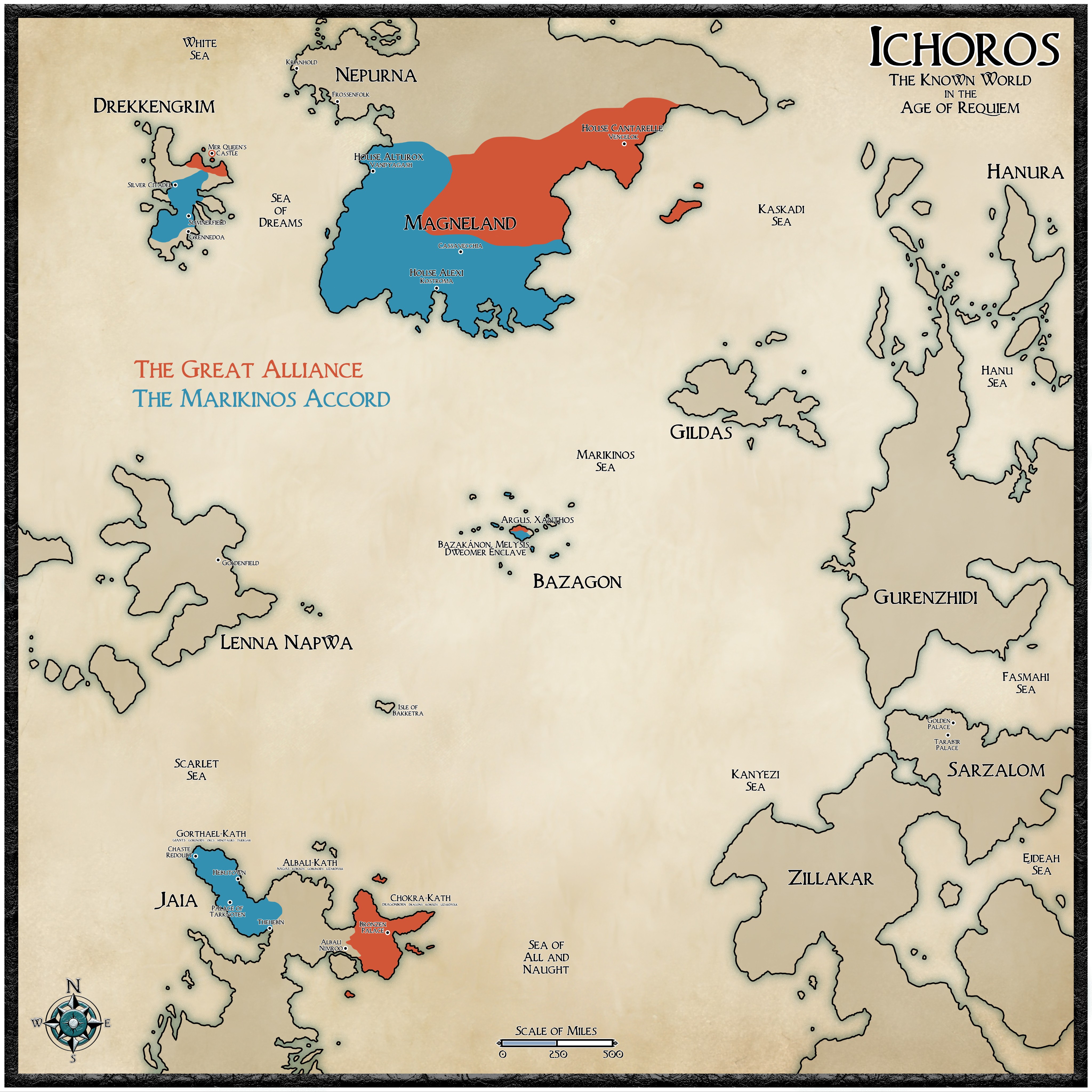
• Eastern Jaia (dragonborn kingdom of Chokra-Kath; King Fothagal the Dread Blue)
• Eastern Magneland (Vencelok and its subjects; King Sondor Cantarelle)
• Bazagon (Xanthos Throne, Argus Legion)
• Drekkengrim (Amarantha the Mer Queen and her subjects, Wraithstone)
• Western Jaia (giant kingdom of Gorthael-Kath; King Ahkenaten)
• Southern Magneland (Kostroma and its subjects; King Gavril Alexi "The Boy King")
• Northwestern Magneland (Vandyagash and its subjects; King Velis Alturox "The Wyrm King")
• Bazagon (Bazakánon Republic, Melysis Hold, Dweomer Enclave)
• Drekkengrim (Silver Citadel, Sumnerfield, Rawkness, Osterwarden, Norgal's Rock)
• Central Jaia (naga kingdom of Albali-Kath; fights against both Eastern and Western Jaia)
• Hebutown (holds neutrality; is spared from the fighting and allabons; many Jaí flee here)
• The Chaste Redoubt (holds neutrality; is spared from the fighting and allabons)
• The Vixphoi Carnival (opportunistically exploits the warring factions)
• The Horned Ones (the minotaur clans sporadically fights against the warring factions)
• Grennedoa (remains stubbornly neutral, only fighting against encroaching forces of the Mer Queen on a few occasions; years later in the war, Grennedoa does join as an ally of Sumnerfield).
• Ishkadam (initially declares neutrality and isolationism; after much pressure, fights in alliance with the Mer Queen in two battles; later betrayed the Mer Queen and fights against her forces in the Isle of Ish region)
Battles rage in each theatre of war. Ancient grudges flare into bloodshed in Jaia, Magneland, and Bazagon, and in Drekkengrim, the Mer Queen and her forces—including contingents of undead—scourge the various folk of the nation. The Realms’ War already promises to be an event of staggering lethality. Even before the worst of it comes to pass, people have an ominous sense of some impending doom. Sages and soothsayers whisper of bloodchilling portents and of glimpsing a future day filled woeful lamentation.
With winter’s frost still clinging to the land, the 535th year of the Age of Conquest commences trembling. Magneland trembles in a literal sense, for House Cantarelle of Vencelok has deployed The Colossus. This wonder of artifice is essentially a construct titan. It is a metal giant that towers over even the tallest of storm giants. A crew operates it from internal chambers, though surprisingly few men are needed—few, though highly specialized. The Colossus can issue long-range spell blasts, though its true power lies in the strength of its limbs and in its indestructible defenses. Many claim that the energy source powering The Colossus is the spirit of a god who was defeated in the Age of Cataclysms. Within its first three months, The Colossus topples groves of trees and pulverizes entire towns. Despite Kostroma and Vandyagash’s attempts, nothing inflicts serious damage against The Colossus, not siege weapons, not spells, and not champions wielding legendary weapons.

More than ten years have passed since The Realms’ War began. Many incredible battles occur during this time, some of which continue to fascinate historians and students of war to this day. At certain times and places, the fighting stalls out, and there is even a brief period in which a potential end to the war is discussed by world leaders. This glimmer of hope quickly fades when the giants of Gorthael-Kath achieve a spectacular victory at Mawa Alta, taking the second-largest city in the dragonborn kingdom.
In Bazagon, the Bazakánon Republic suffers from repeated tactical missteps and failures in supply lines due to their cumbersome republic structure. As one of the first peoples of the world of Ichoros, the Bazakánon have a proud ancestry. They have historically been among the strongest forces of The Middle Isles, but The Realms’ War came at a time in which their society is in an experimental or transitional phase, and a period in which their leaders are uncharacteristically inadequate. These pre-existing destabilizing factors lead to something no one ever thought possible: the fall of the Bazakánon Republic.
Though there are many complexities and variables in The Realms’ War, a general overview shows us that The Great Alliance is advancing toward victory in Magneland and Bazagon, while The Marikinos Accord is showing signs of winning in Jaia. In Drekkengrim, the united folk have struck several decisive blows against the forces of the Mer Queen, and yet she has lost almost no territory of her own, and her spellwrought plagues have wracked a number of enemy companies and towns. She and her dread captains are also able to make undead soldiers out of the bodies of those they kill, which mitigates the losses she has suffered in other battles.
Though The Realms’ War has gone through stretches of deadlocks, it is also punctuated by intense battles along with some monumental victories and staggering defeats on all sides.

If history proves anything, it is that mortals are at their worst when they try to be as gods. It is thus with tear-laden eyes that we watch the closing of the 536th year of the Age of Conquest. The first functional allabons are completed by the dragonborn of Chokra-Kath and deployed against the giants of Gorthael-Kath.
In the Stones of Hongmar region they unleash Stone Rain, which pulls the rocks from the surface of the land then flings them back down. This process repeats in intermittent cycles, with the first several volleys able to launch boulders weighing thousands of pounds each. All structures in the region are demolished, except for the very mightiest of constructions built by grandmaster stone giants, such as the Palace of Tarknoten, the king of Gorthael-Kath at this time. The stone rain continues to the present day, though it only has enough force to gather up stones no larger than fist-sized.
In Thehebín the Golden City, the dragonborn deploy the allabon Fanged Hurricane, causing a typhoon with wind speeds up to 330 miles per hour. Not only does this storm wreck the buildings of the city, but gnashing dragon spirits fly upon the winds. Thehebín, the giants’ wealthiest settlement, becomes a ruin in the span of a single day.
In the Endless Blades grassland of western Jaia, the dragonborn unleash Pyroclasm, which causes volcanic eruptions and firestorms throughout the region, destroying most forms of life and blotting out the sky with ash. The giants’ food production is greatly diminished from this strike, and wildfires spread for weeks and weeks on end. This region of Jaia is now the Ash Wastes.
These attacks are harrowing in their scope and brutality. But the worst is yet to come, for even as these first few allabons shriek their death knells upon the world, many more are nearing their completion.
The final year of The Realms’ War is a descent into an apocalyptic nightmare for so many. Vencelok, Kostroma, and Vandyagash successfully complete allabons in Magneland. House Alturox of Vandyagash also sells two allabons to Amarantha the Mer Queen in Drekkengrim. House Alexi of Kostroma is unaware of this deal. Gorthael-Kath and Albali-Kath complete their own allabons in Jaia, and Chokra-Kath finishes more as well.
In Magneland, it takes two allabons to defeat the Colossus of Vencelok at the Battle of Edrida Valley. Shattering Star shoots a magic missile, which instantly splits into two missiles, which then double themselves, and the process repeats at such speed that by the time the missiles strike, there are thousands of them. Worldbreaker is an orb that cracks open the ground, swallowing a 2-mile diameter in a deep pit of rubble, with The Colossus buried at the bottom. House Cantarelle responds by striking Baycastle in the contested region of Lacuriest, from which Kostroma’s forward offenses are operating. Cantarelle activates Ice of Tafocain, creating a storm of supernatural ice that coats whole miles of the land, freezing so bitterly and so deeply that even steel shatters like glass. The waves in Shield Bay turn to ice, trapping ships whose crews turn to statues.
Many other allabons are used throughout Magneland, each more horrifying than the last. The last one is launched by the sorcerer-king Velis Alturox against the city of Vencelok. Tines of the Netherworld calls up massive spikes from the ground, destroying many of the city’s structures. From these colossal spikes emerge wormlike monstrosities that spread throughout Vencelok, killing and devouring any person or beast they come across. All of Magneland is shocked by this attack. Even to those who are enemies of House Cantarelle, Vencelok is one of the three great cities of Magneland and stands for Magnelandish culture. Its destruction is felt as a killing of part of the realm’s very spirit. Furthermore, there are grave worries that Velis has gone mad in his pursuit of arcane power and that he will fashion more allabons to use against Kostroma or elsewhere. King Gavril Alexi issues an order that Velis Alturox, his councilors and commanders, all be brought to justice. The Kostroman Army is unable to march to Vandyagash, however, as it is soon discovered that much of the realm is covered in thick, supernatural mists, an arcane blight resulting from the allabons.
In Drekkengrim, the Mer Queen deploys her two allabons. She rings the Bell of Crann Ollmor, which cracks open and spawns a twisted avatar of the namesake titan. This colossal, multi-limbed monster resembles a terrifying mockery of a treefolk, and it proceeds to destroy the city of Rawkness in the Bevoran Moeras region. It then heads westward across the Valling Shelf, wracking the land as it goes, and arrives at the town of Glav. The archmages of the Silver Citadel engage the avatar of Crann Ollmor there, and with the aid of a host of angels that arrives at the holy site, they defeat the titan. Glav is reduced to ruins before the fighting ends.
The Mer Queen’s second allabon shows similarities to Tines of the Netherworld that Velis Alturox deployed. When ships out of Sumnerfield and Grennedoa approach her water castle, she unleashes Dread Spires. Massive rocks spike up from the ocean floor, sundering most of the enemy ships. A few of the spires spew out swarms of tiny worm-like creatures that latch onto anyone they touch, spreading necrosis and turning the victims into undead. Two ships manage to escape. One returns to Sumnerfield, where the ship is condemned and burned. The other one disappears, with rumors claiming that it crashed at Dens Moeras or Dusk Isle or was lost at sea with the entire crew turned to ghoulish undead by the worms. Drekkengrim rallies on the whole, and over the next few months, win a number of victories against the forces of the Mer Queen. She and her gruesome allies retreat to her water castle and to Wraithstone. Though the fighting settles down substantially, the conflict does not reach a definitive end, and almost eighty years later, the Mer Queen assaults the land once again.
The worst and most tragic destruction of the war, however, takes place in Jaia. Scores of allabons are deployed, far more than in Magneland. Some have wider-reaching effects than others, but all have cataclysmic consequences. The most lethal of the Jaí allabons is Death Wind, sent out by the dragonborn of Chokra-Kath against Albali-Kath. This massive, burning wind evaporates the water from flora and fauna, from ground and air. The largest rivers are reduced trickles, the deepest lakes turn to mud puddles. The heart of the Jaia continent, once beautiful and even lush in areas, becomes a withered desert.

The Realms' War concludes and is dubbed the War of Three Dooms. Most life in Jaia has been obliterated, and its regions are reduced to wastelands. About half of all life in Magneland is eradicated, and large portions of the nation and the Sea of Dreams are left covered in blight mists; this blight does not reach the Bounty of the South/Kostroma nor the Gnarlwood/Vandyagash. Northeastern Drekkengrim experiences extreme environmental effects, and most life there experiences major disturbances.
Another effect this war had on the world was how it prompted many migrations of people and also of animals. For example, the city-state of Hebutown in Jaia, which is situated in a secluded, coastal-mountain region, remained neutral throughout The Realms’ War. Its population swelled during the conflict from the amount of refugees fleeing their homes.
It is difficult to express just how disastrous this war and its dooms were. Not since the clashes between deities during the Age of Cataclysms has the world seen such devastation.
The fighting in Bazagon reached a conclusion not long after the Bazakánon Republic collapsed. The remaining factions each gain some territory and amount of political power, though the Xanthos Throne more than any other. Fortunately for all, no allabons were deployed in Bazagon, though the threat of it was ever present throughout the war.
In Magneland, with House Cantarelle annihilated, Houses Alexi and Alturox are the clear victors. Tensions quickly rise between the two, with King Gavril’s decree against Velis Alturox and his elite companions, and with so many worrying that the Alturox will continue to create allabons. Velis is a deadly sorcerer-king driven mad by arcane power. A small force of champions are dispatched from Kostroma to an Alturox tomb in the Gnarlwood Region, nowadays known as the Barrow of the Wyrm King. There, these legendary warriors and mages strike down Velis and a number of his top commanders. Kostroman squads arrive by sea in Vandyagash, whereupon a localized conflict ensues. House Alturox and many of their retainers refuse to surrender, fighting to the death in many cases. In the end, Kostroma prevails, and House Alturox is wiped out. To this day, the ruler of Vandyagash is not a king, but rather a count who is loyal to the throne of Kostroma. The blight mists lay thick over much of the realm, causing all manner of ills. Some are poisonous gasses, others transform people and animals into abominations, and others spirit people away to unknown places. These mists last until the Luminous Procession in the year 617, when the Keepers of the Silver Flame bring about the reincarnation of Illus the Lantern, who ascends to the sky as a star constellation and burns away the dreadful fog from Magneland and the Sea Dreams. The road to Magneland’s recovery and the reclamation of its territories is a long one, the realm is still struggling. Despite the shadows of the past looming over the folk of the land, there is an ever-present beacon of hope glimmering in the sky each and every night.
A final note is about the existence of allabons nowadays. There are currently no known allabons in Ichoros. According to all major authorities, including the Mithral Emperor himself, all texts that have been discovered which describe the processes of allabon creation have been destroyed. Though this does not mean that the search for such texts has concluded. Multiple expeditions are being carried out in Magneland and Jaia, with scouts, explorers, and relic hunters of all kinds seeking any potential remnants of these superweapons.