by Esper the Bard
•
Updated 12 months ago
Year 611–618 of the Age of Conquest
Video Version: See this record in video form
“That which can be done, must be done. He who does not carry out all of his capabilities has failed to manifest the full extent of his being. Until you reach your maximum, you cannot reach beyond.”
—Nergoy the Three-Headed
“Do things not merely because you have the power to do them, but instead, do that which is wise. Restraint of impulse is freedom of the soul. Until you become a beacon of life and a bearer of truth, you remain shackled.”
—Illus the Lantern
The Infernal War was the most recent mass-scale war in Ichoros. It spanned years 611 to 618 of the Age of Conquest, ending just thirteen years ago, as of the creation of this record. However, the seeds of this war were planted in the distant past. Several incredible and supernatural events are associated with the Infernal War. Prophecies, mighty and forbidden magic, the reincarnation of gods, the Luminous Procession—these and many more surround this most fated of time periods in the history of Ichoros.
This record covers several historical moments, as many pieces are necessary in order to grasp the full impact of the Infernal War.
Furthermore, a general familiarity with the War of Three Dooms is also helpful for understanding the complete meaning of the Infernal War.
The first eon of the world is known as the Age of Cataclysms, during which gods, titans, and other beings of superior power existed physically in the world, battling one another in epic clashes. The Age of Cataclysms spanned unknown millennia. Due to this open-endedness, its years are recorded in reverse order, counting down until year 1. The earliest event documented by mortals is circa year 3,100, which is the death of the god Mitra-Satsil, he who is known as the Mithral Dragon, the Sire of all Dragonkind. He was slain in the realm of Jaia by the archfiend Ashmodai, the leader of fallen angels in the Dread Domains of Hell.
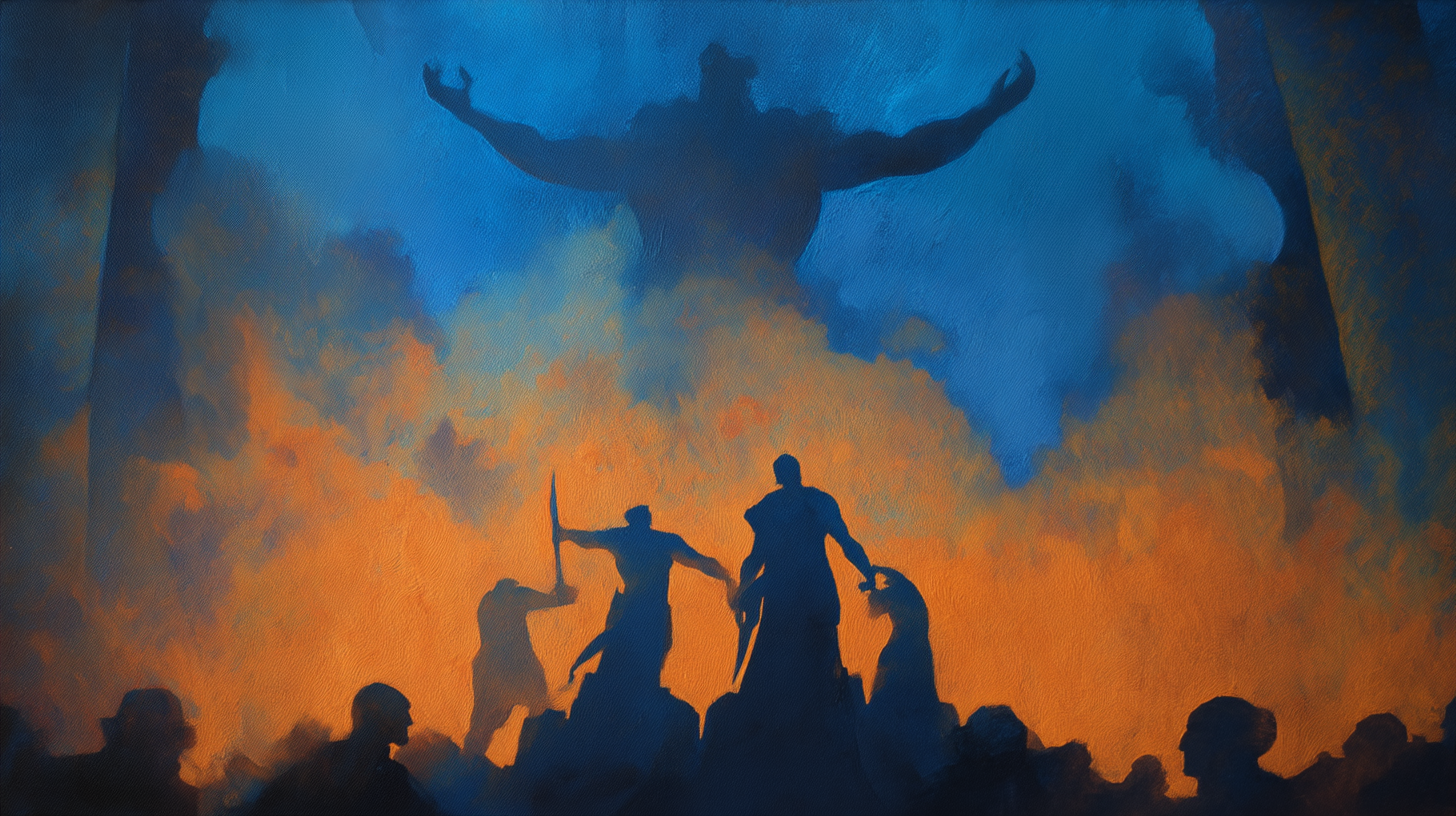
Due to the immense power that gods possess, death affects them in peculiar ways. Their spirits enter diminished, latent states and sometimes are exiled to the edges of the cosmos. The physical bodies of fallen deities typically become as huge statues, known as corpus-idols, though there are exceptions, such as in the case of Illus the Lantern:
His death occurs in the year 877, when he is slain by the titan Vorstbrand. This takes place at Illus’s temple-palace of Omenmox in the realm of Gleomere, which is modern-day Drekkengrim. Upon Illus’s death, his body bursts in a tremendous explosion of light, and fragments of it are flung across the realms, cooling and hardening into prismatic shards.
Soon after this battle, Vorstbrand perishes from a curse Illus placed on him. By this point in history, very few beings of superior power still exist in the world. The frequency of their conflicts is greatly reduced.
Deities, titans, archfiends, and other tremendous powers have battled for control of the Material Plane, and throughout their struggles, they have slain or banished one another. Through these clashes, their blood—known as ichor—seeps into the world itself, which gives rise to its very name—Ichoros.
When the material bodies of the gods die, it causes many supernatural effects:
Some years before his death, Illus the Lantern had created a council of celestial arbiters known as Tessari’dekhana the Overseers. Illus gave them the power to create a single new god, which was Argus the Watcher, a living citadel made to defend Bazagon, which is a large island and archipelago at the center of the world and the very place where the divines had originally created mortal life.
In the year 638 of the Age of Cataclysms, the Tessari'dekhana issue a cosmic law declaring that beings of superior power are forbidden from direct presence on the Material Plane. The spirits of the Ethereal Plane are in accordance with this law, for they wish that the world never again be a battlefield for such cataclysmic forces. This interplanar law is known as the Great Concordance.
At this point, the final god living physically in the world is Argus the Watcher. He is the last one standing when the epic-scale warring comes to an end. Stubborn and prideful, Argus refuses to ascend from the world, considering it a point of honor and duty that he remain the keeper of Bazagon. The gods are locked in debate on how to uphold the Great Concordance. This debate includes Tessari’dekhana the Overseers and those gods who have sufficiently recovered from their diminished states after their physical deaths. Meanwhile, the spirits of the Ethereal have no such debate. They gather and descend upon Argus the Watcher. After 40 days of ceaseless attack by hosts of primal spirits, Argus perishes, still standing upright. His armor, shield, and weapons oxidize, making his corpus-idol resemble a giant of patina and calcification.
The Bazagon Archipelago, particularly the main island, Bazagon City, is famous for the variety of peoples and creatures who populate it. This array of life is due to the many waves of migration and conquest that Bazagon has seen over the centuries. Looking into this realm’s distant past, there were four original peoples: the Bazakánon (humans; lit. "jar makers"), the Horned Ones (minotaur clans), the Bearded Ones (dwarf clans), and the Glantazedes (humans; lit. "revelers").
Circa the year 2,800 in the Age of Cataclysms, Bazagon City is established, with the Labyrinth Lord cutting a covenant with these four peoples of The Middle Isles. The city grows over time, developing into other cities and eventually a metropolis that covers the entirety of the main island. Bazagon becomes the jewel of civilization and the mecca which holds the highest amount of corpus-idols. This also means it is ripe for internal and external conflict. The geography of Bazagon is incredibly unique, as its various districts are separated from each other by bewildering labyrinths, thus giving it the moniker City of Mazes.
The Age of Cataclysms, as stated, is dated in reverse order, with its years counting down. The event to which this countdown is related is when the Melysis elves from Gildas conquer a section of Bazagon. This is the first time a foreign power has gained a hold in Bazagon, and it ushers in the Age of Conquest. The Melysis cultivate the Splintwood and the Melysis Plantation, and they build the Palace of Mitra. At this point in time, Mitra-Satsil the Mithral Dragon is a long-lost and forgotten god; the Melysis bring their cults of the elven goddess Mitra the Wyrm of Life and Death, who is depicted as limbless wyrm with a head like that of a woman.
Very early in the Age of Conquest, the Glantazedes of Bazagon gain territory in southern Magneland. The areas they claim are mostly wilderness in the beginning, though a few centuries later, they carry out ambitious and bloody conquests in many regions of Magneland. The Glantazedes, much like the Bazakánon, is composed of a number of great houses (ancestral bloodlines with honor and wealth). The most prominent and wealthiest of them is House Xanthos.
In the year 180 of the Age of Conquest, members of House Xanthos begin making pacts with archfiends for supernatural power. They conquer more territory in Bazagon City, in particular, the northeastern districts of Hightable and Altum Atrium. New, beholden noble houses are established, such as Sravassa and Detraxi. Those who wield infernal magic are shocked when their children are born with devilish features. These traits, both physical and personality-based, pass onto future generations. This bloodline curse thus commences the tiefling race. Within seventy years, the members of Xanthos (and their closely-related beholden houses) have become entirely tiefling.
In the year 460, Xanthos and a number of noble dwarf clans ally with each other, thus forming the Xanthos Throne. They become the wealthiest faction in the history of Bazagon.
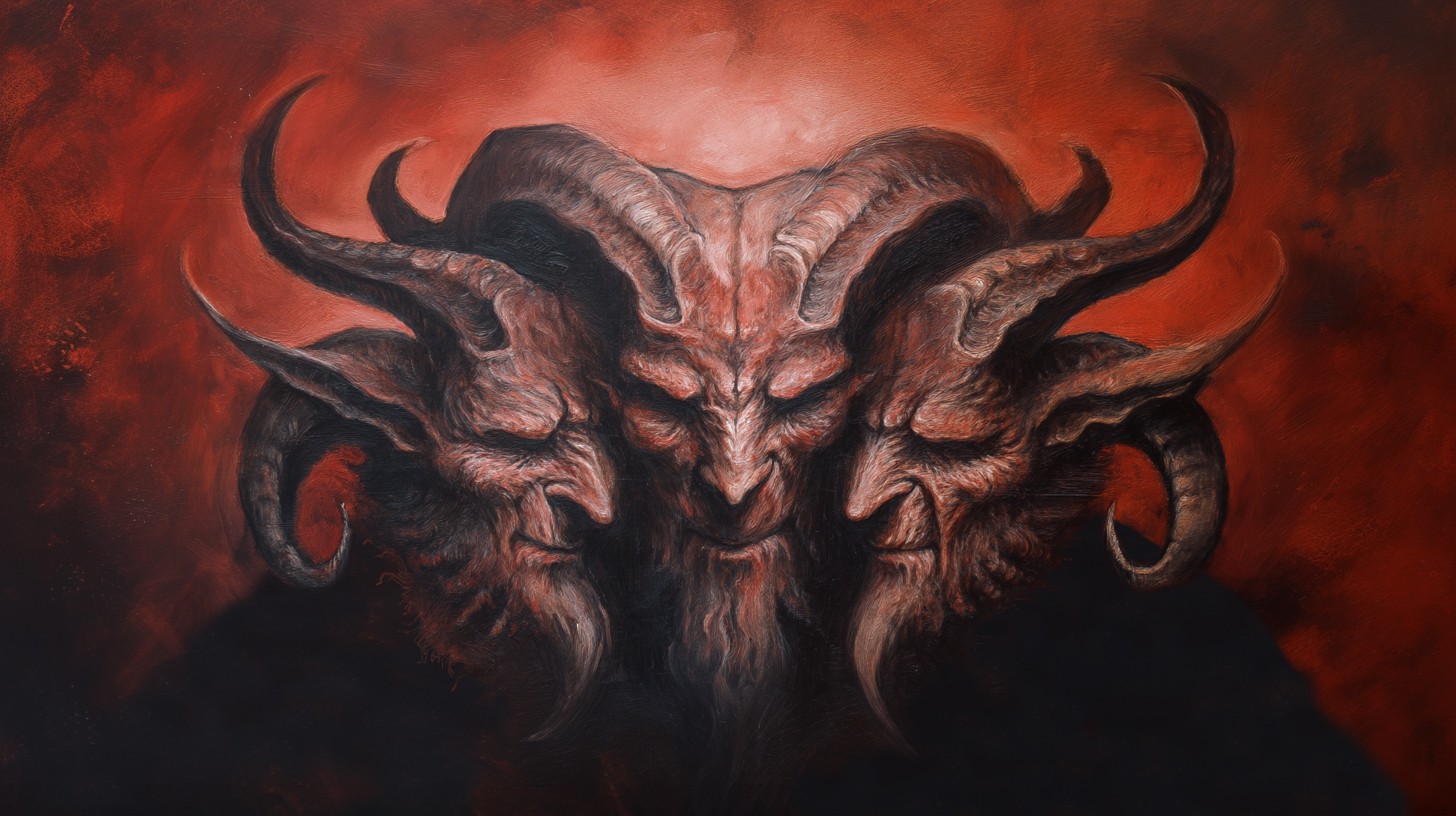
The evil-aligned plane of Hell, properly known as the Dread Domains of Hell, is a place of corruption, vast and dark. Some evil-aligned gods dwell there, though even more numerous are the archfiends, who are highly intelligent fiends of superior power. They are the mightiest of demons, devils, and other evil spirits. Many archfiends rule their own domains in Hell, expressing their malevolent will over their subjects and the landscape. One such archfiend is Nergoy the Three-Headed, whose domain is the Tower of Ash and Frost.
Originally, Nergoy is a giant, a three-headed lord in Gorthael-Kath, the kingdom of western Jaia. For many long years, he lives in the world, and is known for his great abilities in warfare and artifice. He eventually becomes involved with Ashmodai, the Prince of Fallen Angels, and descends to Hell to become his Master of Artifice. Infernal corruption transforms Nergoy into a powerful devil over time. After serving for centuries, he breaks away from Ashmodai, gathering his own followers and erecting his Tower of Ash, where magical armaments and machines of war are constructed. Nergoy later goes on to lead a conquest of an extremely cold region of the Dread Domains. His forces defeat the ruling archfiend there, and Nergoy claims a powerful magic item known as the Frozen Heart of Hell. As well, he claims the rank of archfiend.
His obsessions with artifice and magic only grow, as does his ambitious pride. In the late 5th century of the Age of Conquest, Nergoy begins to clandestinely bargain with various powerful magic-users in the Mortal World, using his agents there. He dares not attempt to physically enter Ichoros due to the Great Concordance and thus relies on divinations and portals to trade arcane secrets with archmages in Magneland, and with elder rune-carver giants in western Jaia, and with the highest dragon sorcerers in eastern Jaia. He provides them with partial knowledge of how to create superweapons known as allabons, and in exchange, these contacts provide him with knowledge of interplanar magic and with rare arcane components that he could not otherwise access within Hell.
In the year 525, war breaks out in Jaia. It is called the Kingdoms’ War at first, but within three years, the fighting spreads to other parts of Ichoros, and the conflict is renamed the Realms’ War. By 536, the magic-users who had traded knowledge with Nergoy a few decades ago have completed functional allabons. They unleash devastating mass weapons in Jaia, Magneland, and to a lesser extent, Drekkengrim. The loss of life is unimaginable. Jaia, which historically had many fertile regions, is reduced to blasted wastelands, and the majority of its population perishes. Many regions of Magneland are devastated, suffering extreme losses of life, and much of its territory and the Sea of Dreams are left shrouded in blight mists. Northern Drekkengrim is devastated, and even though its central and southern regions suffer no apocalypses, the realm becomes isolated due to the arcane mists engulfing the sea.
The war is ultimately named the War of Three Dooms, and many lament it as the most lethal event of the Age of Conquest. Little did anyone know that it was the archfiend Nergoy who provided the information that led to the construction of the allabons to begin with. Such devices are unanimously condemned by leaders across the world. Allabons are outlawed to the highest degree, and any known records that contain information regarding their construction are destroyed.
In the late 6th century of the Age of Conquest, a boy named Anji is born to a human father and an elven mother in the village of Brolton, in Magneland. The center of the village has a raised beacon of white flame, a sturdy column of stone, with a brazier atop it, whose bright light never extinguishes. These flames mysteriously appeared when the dread mists fell across the land after the War of Three Dooms. The fire provides a radius of protection that spans miles and holds the Arcane Blight at bay.
Anji’s father is an eccentric adventurer obsessed with prophecy and esoteric knowledge. He disappears on an expedition into the mists, which devastates Anji’s family. Curiously, he left Anji an unusual item—a plain mask of white leather. Anji experiences strange dreams, and he often remembers his father raving about a mithral dragon who would make a glorious appearance. As far as anyone knows, no such dragon exists.
One night, Anji awakens from the grips of a disturbing dream in which he died and was reborn in a body of pale silver. He takes a walk in the cold air to clear his head, and a stranger appears to him, a dark druid named Rechnirog who claims he can walk through the blight mists unscathed. He offers to lead Anji to Kostroma, the capital of Magneland, which lies at the southern edge of the continent, well beyond the mists. It would be a new life away from the grief and the Arcane Blight. Anji initially refuses, but as the weeks pass, his dreams continue. Questions burn within him. Is his father gone forever? What is the meaning of the mask? Would this great mithral dragon truly come? He realizes fate is calling him to something greater. Against the pleas of his mother and his sister Twyla, he leaves with Rechnirog the blightwalker.
After what seems like a clouded nightmare, Anji arrives in Kostroma. Rechnirog says he will collect repayment for the passage at a later date, and he leaves the half-elf to fend for himself. Without money, home, or friends, Anji takes to living as a street thief. His natural agility and luck serve him well, and his mask hides his identity. On several occasions, he narrowly avoids capture, earning himself the moniker of the Hummingbird. After a time, his luck falters, and he is imprisoned. He is sold to a pit master and sent by ship to Bazagon to serve as a gladiator. In the City of Mazes, Anji utilizes his Hummingbird style in the fighting pits and always wears his iconic mask. The pit master pays for him to be trained in an exotic martial arts style, which proves a wonderful complement to his innate abilities.
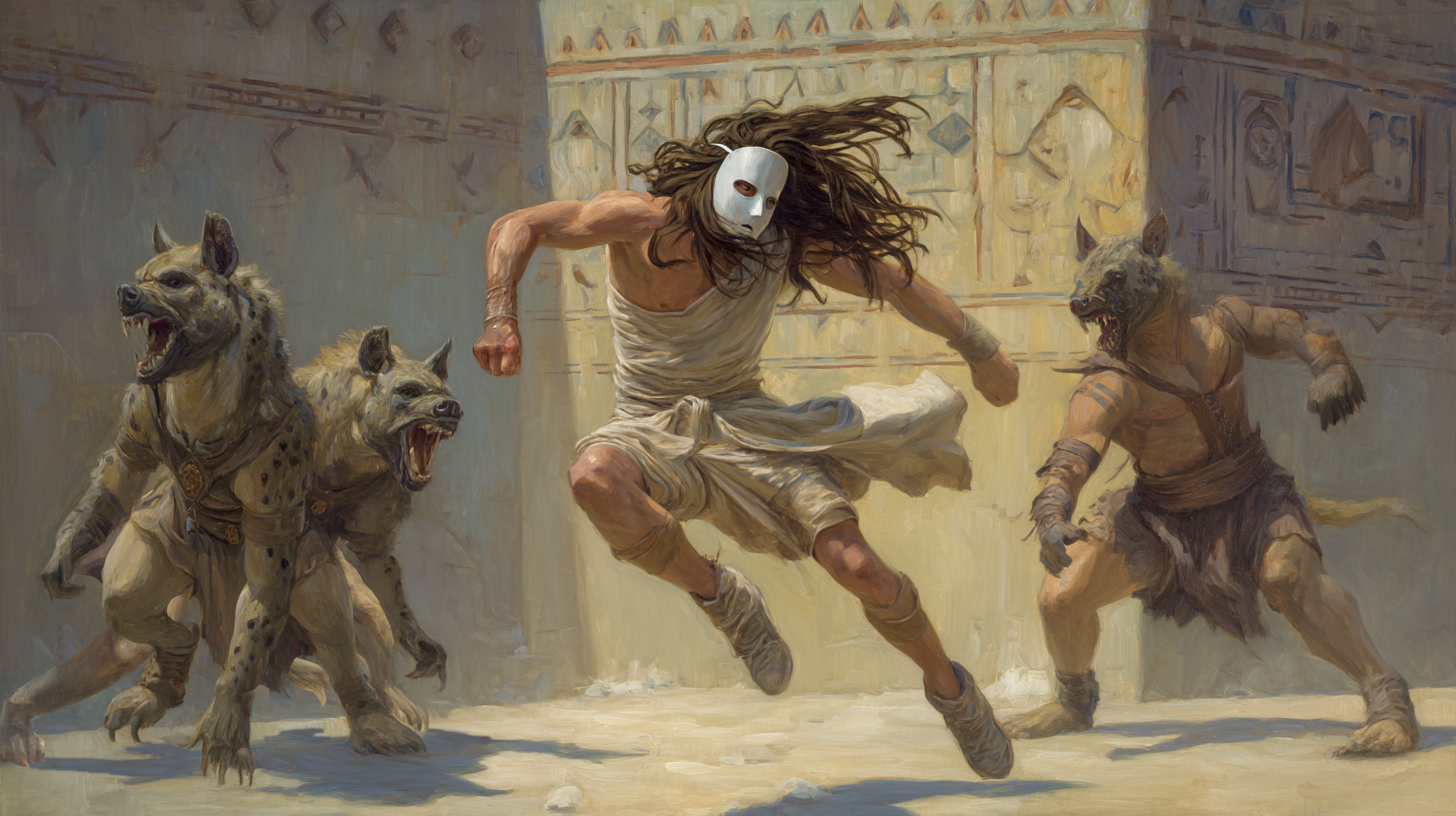
Anji grows in fame and skill. Three fellow arena competitors come to fight alongside him as a team: Pyros, a fire sorcerer with draconic ancestry in his blood, Yoni, a dark elf loremaster and bardic mage, and Paelios, a warrior, tracker, and dungeoneer. After their success in the Clash at Onyx Isle, Anji and his companions win their freedom and their citizenhood in Bazagon. They found their adventuring company, naming it Phantasmagencia. They soon become involved with the Melysis Hold faction, which leads them onto a series of bewildering expeditions.
In the underground district of Bog Bottom, Phantasmagencia comes across a cult of Mitra the Wyrm of Life and Death. Their religious art shows Mitra not with a woman’s head, but with a draconic head. They embrace a mystery that this deity is dualistic, not only one of life and death, but also female and male. Among this cult is a priestess of Mitra who was prophesied to birth the reincarnation of Mitra, but she is 40 years of age and seems to be sterile. She and her husband have never conceived. Pyros the fire sorcerer seduces this priestess in secret and has relations with her.
Phantasmagencia goes on to undertake numerous adventures. These journeys are as mystical as they are perilous. Anji’s guile and fast cunning are only outshone by his audacious daring and his incredible knack for narrowly escaping death—permanent death, that is, for Anji dies is revivified multiple times and even reincarnated once, miraculously reforming in the body of a silvery high elf, much like the dream he had years prior.
His exploits are many and often unbelievable. He is sliced in a blade trap chamber in the Royal Crypt, burned in an acid plunge trap in Bog Bottom, and cursed by a gem of undeath in a ruined temple of Rhodelm the Scarab in Jaia. A spirit-knight comes to his service after he draws a card from a deck of many things, he confronts and masters his dark side at the Shadow Temple, and he learns various forms of combat techniques and magical abilities throughout the years. Other brave and wondrous souls join with Phantasmagencia on certain adventures, such as Anji’s own sister, Twyla, who has gained abilities with fey magic; and the storm-wielding battlepriest Galvanos and the honorable and celestial-blessed Elka, both of whom hail from the brumal northern realm of Nepurna.
During a particular quest in western Jaia, Phantasmagencia finds their way to the Palace of Tarknoten, who was the last king of Gorthael-Kath. There they discover the final remnants of the giants. Amongst the empty and forlorn halls, there are a few old stone giants, and a number of duergar and oread retainers. They guard the Sphere of Elemental Earth, a powerful artifact controlled by the giants since time immemorial. Phantasmagencia cannot resist the prospect of such plunder. They issue a challenge to the giants, manage to defeat them in combat—though do not slay them—and steal off with the Sphere of Elemental Earth. They are not in possession of this artifact for long, for they are bested by the Witches of Whiptail in the Scrub Wastes of Jaia. The hags take off with the elemental sphere as well as the petrified body of Elka. They barter both of these to none other than the archfiend Nergoy. In return, they receive a squad of powerful demons to command.
At this point in time, Phantasmagencia has made close acquaintance with Straegor Alexi, of the royal bloodline of Magneland. Straegor is a half-orc, and has long suffered the taboo of his partial orcish lineage. Despite this apparent disadvantage, he has managed to rise to acclaim and honor in his realm, for he is a paragon of Illus of Lantern, blessed by that righteous god of light and wielding a legendary silver weapon called Solemnedril.
The Witches of Whiptail further manipulate Phantasmagencia by sending their most cunning fiends to steal away with Straegor’s weapon. Anji and his comrades ally with Straegor on a hunt to reclaim his crescent-bladed armament. They break into a misbegotten dungeon where the demons are lurking, and in their rampage, unseal an ancient sphere of annihilation. They strike down a number of the foes, take back Solemnedril, and escape before the sphere disintegrates them. Unbeknownst to Phantasmagencia, the hags had used them to gain access to the sphere of annihilation. The witches wrest control over the sphere and deliver it to the one who had bargained with them to retrieve it—Nergoy.
Phantasmagencia’s wild raids end when they meet their demise in deepest sublevel of the Isle of the Labyrinth Lord. They gravely offend the Dweomer Enclave, bringing upon themselves the wrath of the archmages and other powerful entities. Pyros, Paelios, and Galvanos perish, Yoni is sealed away, and Anji alone escapes, incredibly withstanding symbol spells and the onslaught of mighty foes.
For long years, Nergoy had puzzled over a tremendous problem: How could he launch a campaign in the Mortal World without facing certain defeat for violating the Great Concordance? Entering the Material Plane would bring an impossible ethereal assault upon himself and his thralls, and the Overseers would decree he be brought to justice in the Celestial Panopticon. Yet, the more this barrier seemed insurmountable, the more he desired to overcome it. There was no finer prize than the realms of Ichoros, and he would be the greatest ruler of all time, the one to bring ultimate order to the plane roiling with endless cycles of war—echoes of the gods who had battled for the world and bled into it upon their deaths.
The answer came to Nergoy like a bolt of lightning: He must bring Hell itself to Ichoros. And when he would travel outside of his region, he must wield a weapon great enough to destroy even spirits crossing over from the Ethereal.
He takes part in clandestine dealings with mortals during the Age of Conquest. These exchanges serve dual purposes. The knowledge and magical components he gains from them lead to the mighty arcane rituals he will perform, and the allabons created by the various world factions will serve as a series of tests as to how such devices operate.
The War of Three Dooms plays out, decimating large swaths of the world, all the while showing Nergoy exactly how he should construct his own allabon. It takes decades of refinement, but the Three-Headed archfiend is nothing if not adamant. When all is readied, he and his highest counselors perform the terrible rituals. The first combines the Frozen Heart of Hell, the Sphere of Elemental Earth, and** the sphere of annihilation into a singular artifact of unfathomable power, the Voidstar Primus. It is the most powerful allabon ever created. The second ritual merges Nergoy’s domain with the Material Plane. He selects the most suitable location, the island of Fiendsarok off the western coast of Jaia. It is the place in the world that most resembles his own region, due to its unusual frozen climate and fiendish corruption. Nergoy’s Tower of Ash and Frost spikes up from the ground, and a portion of Hell spreads across the island like a canker upon the face of Ichoros.

The archfiend tours throughout regions of Jaia, surveying firsthand its parched and blasted desolations. Whenever primal spirits descend upon him from the Ethereal, the Voidstar obliterates them at his command. He and his infernal army march to the Seven Cantons of Hebutown, where he crushes an attempt to resist him. Not only are his fiendish soldiers resistant to mortal weapons, but he and his commanders’ powers vastly outmatch those of the opponents. To seal the victory, he gives a single demonstration of the Voidstar’s power—an allabon that does not expend upon usage and that can reduce anything to nothingness, be it physical matter, magic, or otherwise. Hebutown kneels to the conqueror Nergoy, adding to his army.
In the ensuing months, Nergoy’s forces construct ships and strike against locations in Bazagon and Magneland. The Xanthos Throne of Bazagon, however, does not oppose Nergoy. In fact, their leaders have been in communication with Nergoy since well before his incursion. He is even the otherworldly patron to a number of their warlocks. Thus, the wealthy faction led primarily by tieflings grins at the prospect of sitting a high pedestal in the new world empire to come. The Iron Seal is the name borne by the allied forces of Nergoy and Xanthos. Along with them is the Bazagonian faction of the Argus Legion, who joins with little enthusiasm, merely a cold tactical assessment that the Iron Seal will win the forthcoming war.

Fighting intensifies as the weeks and months progress. Those who oppose the Iron Seal call themselves the Hands of Mitra and are led by the Melysis Hold faction along with the Labyrinth Lord. As was seen during the War of Three Dooms, Bazagon is split from within, creating a dire situation of both internal and external threats. A looming terror hangs over the City of Mazes, for everyone knows that it is only a matter of time before Nergoy himself sails to Bazagon to lead a full-scale invasion.
For over a year since the demise of Phantasmagencia, Anji has been in a hermit-like state in his birth town of Brolton, secluded within the mist-choked heart of Magneland. His mother is pleased by his presence, and his sister Twyla abides there as well.
The bardic mage Yoni is freed from his imprisonment by the Labyrinth Lord of Bazagon, on the condition that he aid in the fight against the Iron Seal. He uses sendings to communicate with Anji and inform him of how the Infernal War threatens to subjugate the world under the rule of a diabolic empire. Anji and Twyla make their way to Kostroma with the aid of Rechnirog the blightwalker druid. They meet with Straegor Alexi, who has already been involved in battles against the tiefling forces of the Iron Seal, with mixed results. They form an alliance, and Anji creates a new mask made of mithral.

They lead an offensive against an Iron Seal company and achieve victory, then meet with one Captain Rohaas Spoorbeak, whose crew sails out of Drekkengrim. They are able to navigate the blight-misted Sea of Dreams because their ship, the Levengouger, has a lantern of white flame at its prow, which repels the Arcane Blight, much like the beacon in Anji’s village of Brolton. Captain Rohaas is a daring treasure hunter and adventurer, and he informs Anji and Straegor that there are in fact many of these beacon-pillars throughout Magneland, which safeguard pockets of the land around certain towns. He refers to the magical white fire as manaflame, and says that his ship’s lantern is the only instance of it that is mobile. Straegor receives a vision from his patron god, Illus the Lantern, which hints at his destiny.
With the aid of Captain Rohaas, the party travels by sea northwest to join the fight against the Iron Seal in Nepurna. When they arrive there, they are astounded to find that the invasion of the Mighty North has caused an immense unifying effect between the Brumathane and the Drengir, the two major Nepurnian cultures that have historically been enemies. The battles in Nepurna are harrowing, as the tiefling forces are accompanied by devils, but the Iron Seal is thwarted. Anji and his allies are joined by Hravenaug, a powerful Nepurnian warrior-mage of a heroic bloodline. He aids Yoni in accessing arcane lore, and from this, Yoni masters higher magic. One expression of this is a spell that can shift the party into wind forms such that they can fly over land and sea at a tremendous velocity. Through his lore-mastering process, Yoni learns that this spell was originally created as a gift from the Jaí dragon goddess, Kaimaria the Mother of Wind and Sea, and first given to her son, Shexonthakorr Vivellius.
In wind form, the party travels across the world to Jaia. They go to a mythic pagoda-temple in the Kaharraia Mountains known as the Chaste Redoubt. Here, they gain an audience with the Ancient Ones and learn that Kaimaria’s dragon son is still alive. He is more commonly known as Grey Wind. He is many centuries old, and he dwells within the burnt realm of Jaia, having survived the War of Three Dooms. Anji, Straegor, Yoni, and Hravenaug, through their efforts, win the Ancient Ones and Grey Wind over to their side, as allies in opposition to the Iron Seal. They travel with the dragon to Bazagon and are amazed at how fast he flies, having the speed of the wind-form spell while still maintaining his shape and his fighting abilities.

The party and Grey Wind are received gladly by the Hands of Mitra and heralded as champions. The fighting between the two sides in Bazagon City is a bloody war of attrition, and Nergoy is en route by sea with a trio of massive infernal warships attended by an armada. When he arrives, with his army, his lieutenants, and the Voidstar, the conflict will shift dramatically in favor of the Iron Seal. The Hands of Mitra, however, have two particular strengths:
The first is the Labyrinth Lord. As a mythic being and the Grand Architect of Bazagon, he is able to shift the many mazes of the city and therefore sequester enemy forces or lead them into deathtraps. A major drawback is that the longer he remains outside of the depths of his island, the more he draws the attention of primal spirits, who muster from the Ethereal to assault him for offending the Great Concordance. His existence in the world is something of a gray area. As long as he remains in the chambers far below his isle, the spirits leave him well enough alone.
The second advantage is a reincarnation of Mitra the Wyrm of Life and Death. She was born from the priestess of the cult of Mitra in the subterranean district of Bog Bottom. A few years back, when the priestess fornicated with Pyros the Dragon Sorcerer, she conceived. She gave birth to a daughter with a large mouth and a scaly, serpentine body without limbs. Even though the child is only three years old, she is already prodigious in size, over thirty feet long from head to tail. She is a goddess, or perhaps an aspect of Mitra, and all worship her, despite how she is wildly immature, to the point of being nearly uncontrollable. And she hungers. She devours with a hunger that never quells—food, animals, even people. She had recently been unleashed against a squad of the Argus Legion, and she consumed them in their horror. As with the Labyrinth Lord, there is a tremendous problem in that her presence draws the ire of the Ethereal. When she is kept well below ground and secluded away, the spirits do not move against her. The prelates of the Melysis Hold are in agreement that once she grows in power, even hiding her away will do no good.

Krynth, the High Prelate of Melysis, relays a peculiar anecdote of observing Mitra devouring a spell that was cast at her. Anji’s party persuades Krynth to allow them to test this phenomenon. The clerics who attend the goddess reverently prepare her. Yoni and an archmage from the Dweomer Enclave cast spells at her, ever stronger in degree as they proceed, and Mitra swallows them all, invigorating from the energy. The final spell is disintegrate, cast by the archmage. Mitra consumes it as readily as she did a cantrip. Her excitement comes to a dangerous fervor, and those gathered are forced to draw away from her. They hatch their plan on the spot. When Nergoy reaches Bazagon, the Hands of Mitra will engage him and his forces, and Grey Wind will fly out from a hidden location, carrying Mitra swiftly to the Voidstar, where she will devour it. As cataclysmic as its power is, surely it will be eclipsed by a goddess. She will then wreak havoc upon Nergoy and his forces, until the primal spirits muster against the archfiend and the deity.
One week later, Nergoy and his armada reach Bazagon. Fighting within the City of Mazes has continued at its terrible pace, with bloody strife in all major surface districts as well as in certain underground districts. The Xanthos Throne and the Argus Legion are elated at their emperor’s arrival, seeing it as a certain victory to come. All others shudder at the thought of the archdevil, with his infernal legions and his allabon of unprecedented power.
The warships and other vessels arrive at Bastion Port, which is controlled by the Argus Legion, though currently contested due to the war. Before the invaders can reach the piers, magical assaults ensue. Archmages of the Dweomer Enclave launch tremendous explosions, and Yoni capsizes one of the warships with an upheaval spell.
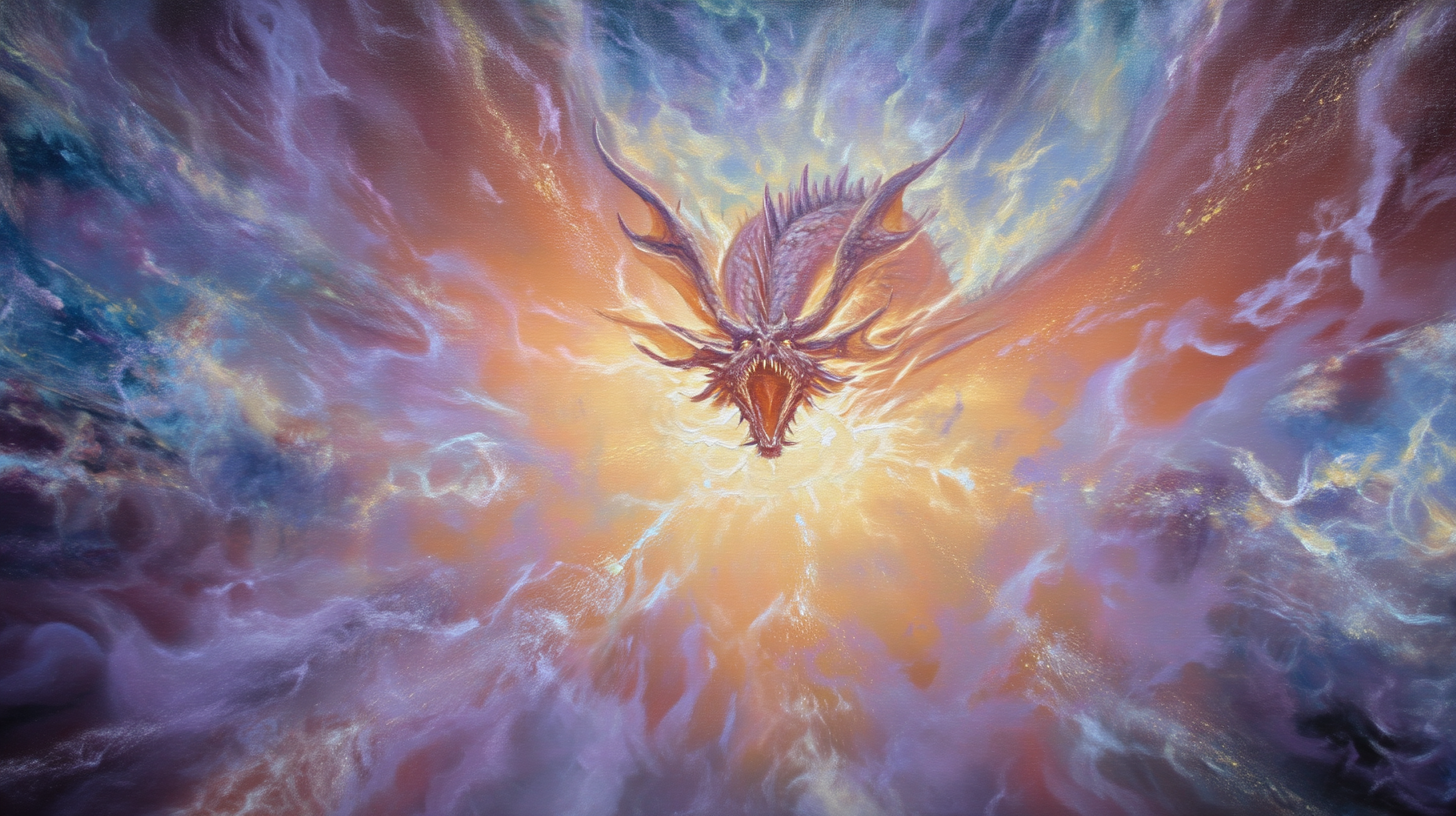
Furious to respond, Nergoy draws closer and sends the Voidstar thrumming through the air. As he issues the command for the allabon to annihilate the mages, Grey Wind erupts forth from a concealed position, clutching Mitra the Wyrm in his foreclaws. He reaches the allabon with hurricane speed, and the fledgling goddess devours the Voidstar at once. Mitra whips about, and her maw opens wide. A vortex pulls everything nearby into Mitra’s gullet, including Grey Wind. She surges with an overwhelming pulse. In that moment, the deity transforms into a complete state—Mitra-Satsil—goddess to god, with mithral scales gleaming, limbs stretching out, and wings spreading. Mitra the Wyrm had been a fragmented portion of the spirit of Mitral-Satsil, and now he is fully reincarnated, with a new body and replenished power. The mad ramblings of Anji’s father now align into majestic clarity. From his jaws, Mitra-Satsil unleashes a blast of force that tears through Nergoy’s troops, sending soldiers and commanders back to the pits of Hell.
Nergoy’s most powerful warlock casts a plane shift that recalls him, the archfiend, and a few of the lieutenants back to the Tower of Ash and Frost. Among the ranks of the invading forces, Anji and his allies come across Elka, their paladin ally, though she has been transformed into a twisted state through infernal rituals. Lamenting her horrific misfortune, they strike her down. The Battle of Bazagon wages for a number of days, with the Iron Seal quickly crumbling. With the full strength of an elder god on their side, the Hands of Mitra claim victory.
Mitra-Satsil the Mithral Dragon rewards the heroes who played their fated roles and brought about his reincarnation. He resurrects Elka in a celestial form, and she takes up the title of Truesilver Justiciar. He appoints Anji as his exarch, and imbues his mithral mask with wondrous powers. He also gives to Anji two pieces from his own body, a scale that serves as a hovering shield, and a fang that serves as a mighty sword.
The Dragon God finds it more and more difficult to remain in the world. He is under constant assault by primal spirits, and the Overseers are in continual contact with him, pressuring him from across the planes to abide by the Great Concordance. After nearly three weeks, Mitra-Satsil ascends from Ichoros to dwell within a palace on the Astral Plane.
The party of heroes makes their way north to Drekkengrim, where Straegor commences a great undertaking. He persuades Captain Rohaas to hand over the lantern of manaflame from his ship. Following the mystical guidance of Straegor’s patron deity, Illus, he leads his party on a pilgrimage from place to place, wherever manaflame burns; first at the Lonesome Lighthouse off the Cairn Coast in Drekkengrim, then throughout Magneland, at various towns and villages that have manaflame beacons. At each of these sanctuary pillars, the white fire enters the lantern that Streagor bears. As the mists of the Arcane Blight will certainly billow in once the heroes leave any given town, Yoni opens a magic gate to Bazagon each time—a great spell bestowed upon him by Mitra-Satsil. These populations are transported from Magneland to a district in Bazagon City known as New Starbreeze, which is in a flurry of construction.
This Luminous Procession plays out across the Great Realm of Magneland, with Straegor and his allies traveling from beacon to beacon, collecting the manaflame, until all of it has been gathered. The elder god Illus the Lantern then reincarnates in a tremendous convergence of divine light. The manaflame had been the fragments of his dissipated spirit. Whole again, he bestows his blessing upon the heroes and appoints Straegor as his exarch. He emboldens the heroes to seek out the Tower of Ash and Frost and strike down Nergoy for good. Illus does not remain in the world, but immediately rises to the Astral Plane. During his ascension, his glorious radiance burns away the blight mists from Magneland and the Sea of Dreams. He takes his place as a star constellation which shines over the northern portion of the world.
The party of living legends thus adopts the name the Keepers of the Silver Flame.
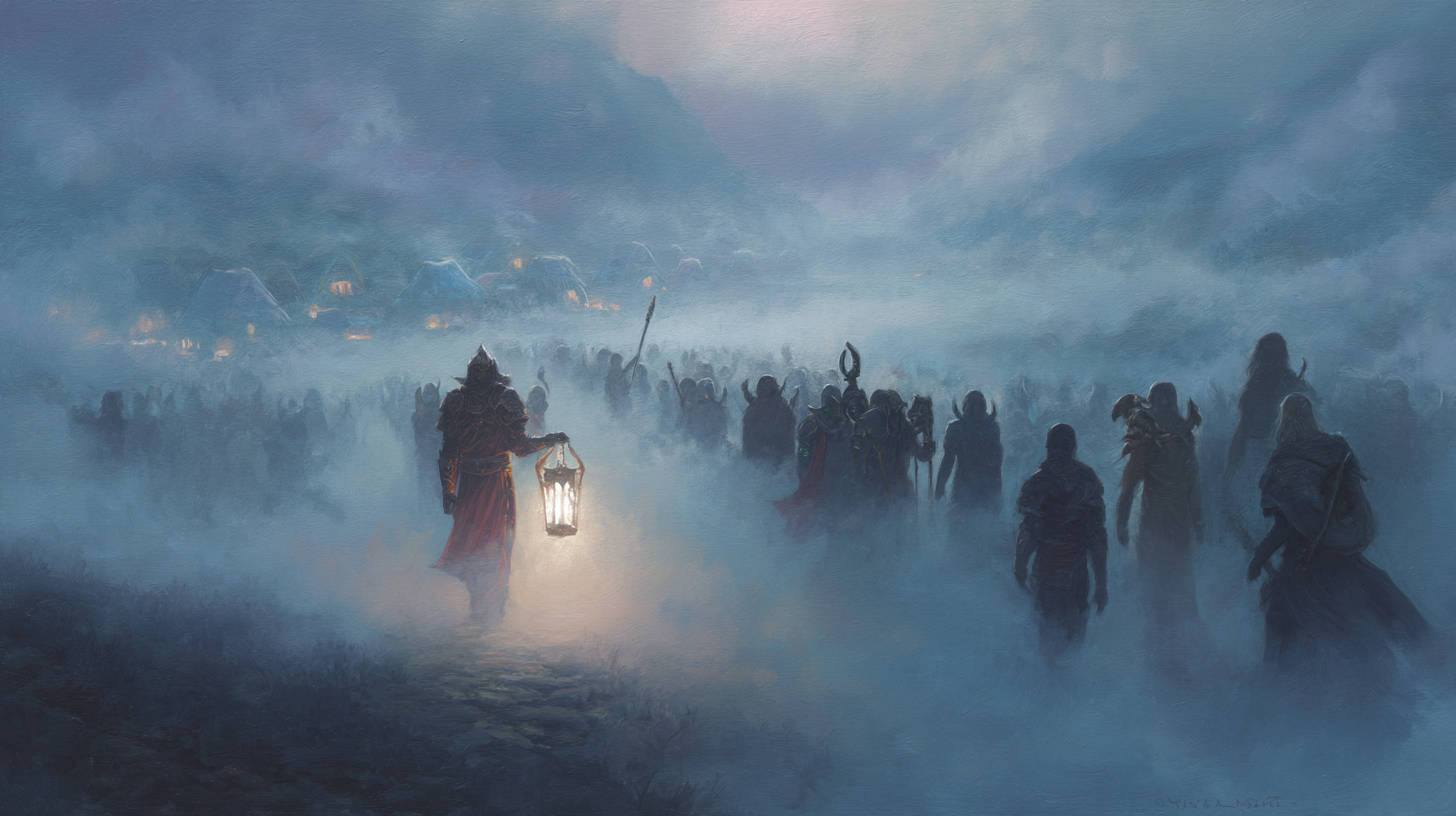
After weeks of preparation, the Keepers lead an offensive against Hebutown, in Jaia. The battle there is short and intense. The main resistance come from the ogres of Cinderwing Canton, the hobgoblins of Ferron Canton, and the minotaurs of Brasshorn Canton. The dragonborn of Dragus Canton also hold the Keepers in contempt for the sacrifice of Grey Wind, son of their mother goddess Kaimaria. Anji attempts to win them over, as he is exarch of the Dragon God reincarnate, and he himself was also reincarnated in his pale silvery form. While he does not gain their alliance, he prevents them from taking part in the fighting. The Keepers of the Silver Flame and the Bazagonian forces achieve victory in Hebutown.
The Keepers then make their way to the frozen isle of Fiendsarok, which is currently a domain of Hell brought into the world. Against unbelievable odds, they effect a righteous assault against the Tower of Ash and Frost. Tieflings, duergar, minotaurs, and devils of all kinds defend the strategic points throughout this gauntlet of dread: a lake of black ice, a frozen ridge, the tower gate, the silent halls, the ritual chamber, the pit of darkness, and the throne room. The forces of evil have overwhelmingly higher numbers, symbol spell-traps, infernal lieutenants, and Nergoy himself, with all his nightmarish archfiend powers. But despite such immensity, the fiends meet their doom. The Keepers of the Silver Flame vanquish them in a battle beyond mortal comprehension. Nergoy’s very spirit is destroyed. The heroes exhibit peak mastery of their abilities, wielding mythic armaments and thriving with the investitures of gods. They return to Bazagon as living legends, veritable demigods.
In accordance with the will of Mitra-Satsil, Bazagon declares the establishment of its empire, with Anji as the Mithral Emperor, also known as the Dragon Emperor, who rules from Bazagon City. The Empire includes large regions of Magneland and Nepurna, as well as Hebutown in Jaia. Colonies are also established, such as Goldenfield in eastern Lenna Napwa and Ammal Jaddi in eastern Jaia. Straegor Alexi is crowned king of Magneland, and Hravenaug is crowned king of Nepurna.
Thus concludes the Age of Conquest and commences the Age of Requiem. As of the writing of this record, thirteen years have passed. The laws of the Bazagonian Empire continue to mount, with the Emperor and his council composing and articulating them in a most complex manner.
He is sometimes in attendance at the Grand Colosseum, watching the games he so favors—the very games that he once competed in. He is both shadow and light, order and chaos, ambition and fate. His dragon-blessed spirit reveres those who achieve glory, skill, and wealth. His celestial nature coupled with his strange background makes him a singularly complex being.
The Labyrinth Lord, whose original name is Roysov Layne, has bestowed his title and his staff to Yoni, who is now the Labyrinth Lord of Bazagon. Roysov Layne henceforth dwells on the Plane of Faerie, free from the pressures of the Great Concordance, for cosmic law allows archfey on the echo planes of the Material.
In the present day, the Mithral Emperor struggles to unify the bewildering array of different peoples in Bazagon and the wider Empire. By principle and by law, the subjects are all expected to uphold fealty to the Empire. But principle and reality are often very different from each other. The complications of ruling bring a level of pressure that even an exarch is troubled to bear. But it is a new age in the world of Ichoros … one of exploration, of reclaiming relics from scarred lands, and of continuing the mythic legacy of the Myriad Legends.